Showing posts with label King of the Flintknappers.. Show all posts

Saturday, January 19, 2013

D.C. WALDORF, HALL OF FAME FLINTKNAPPER # 6


When I was a kid I was very interested in arrowheads. I used to find them once in a while when hunting with my dad and brother. Like many folks dabling in flintknapping I eventually came upon Waldorf's book, "Art of Flintknapping". The books has sold many thousands of copies and is considered a classic. I never had enough flint around to learn his method, but I used to read it and gaze at the photos often. Waldorf also wrote in the original "Flintknappers Exchange" - the classic knapping publication that brought knappers together from academic and folk communities. I met D.C. Waldorf in 1984, through my old newsletter, "Flintknapping Digest"

At eight years old old D.C. became interested in Indian traditional technologies. At about fourteen years of age he discovered the a nail could pry flakes from the edge of broken glass and flint spalls. Later he found that ciopper and deer tines worked better for the pressure knapping method. D.C started percussion knapping about 1968 after reading Howell's book "Early Man". H was, at the time one of only a hand full of knappers on the planet. He joined the Archaeological Society of Ohio. His point become so well made that he was banned from selling or displaying them at the meeting.

Waldorf uses antler and stone for percussion and copper and antler for pressure. D.C. and his wife Val took over the "Flintknapping Digest",at my request, and turned it into "CHIPS" - this was a huge success. He also wrote many other books, including
novels out of his rural Missouri cabin. D.C. and Val made a good living with "Mound Builder Books". Later D.C. Waldorf became one of the pioneers of the new Danish Dagger movement. He worked with other dagger knappers on occasion such as Callahan and Stafford.
>
The International Flintknappers ‘ Hall of Fame and Museum is encouraging individuals of all ages to “Be A Superior Example,” through a new education program as part of a new curriculum to promote healthy habits, while encouraging everyone to live free of drugs and other such substances or vices. It serves as the central point for the study of the history of flintknapping in the United States and beyond, displays flintknapping-related artifacts and exhibits, and honors those who have excelled in the craft, research/ writing, promoting events, and serving the knapping community in an ethical and wilderness loving manner.


          I was born in Norwalk, Ohio on April 29, 1951.  My father told me that I came into this world at dawn after the passage of a violent thunderstorm.  He and his best friend Leo were sitting on the front steps of the old Memorial Hospital, watching a glorious sunrise through the receding clouds when they got the word.  I sometimes wonder how this event would have been interpreted had it happened in a hut beside the Huron River 10 or more centuries earlier!
          Even as a young kid, I felt that I was somehow different, I believe that those around me referred to it as "odd." My love for history and things-old manifested itself very early and indeed, my Great Grandfather Floyd Hill was a collector of all sorts of relics, old swords and guns mostly, with a few arrowheads thrown in.  Perhaps I inherited his "bad gene".  I still have a worn out drill made of shiny black Coshocton chert that my grandmother gave me when I was about 8 years old.  She told me it was all that was left of his great collection.
          I never did very well in grade school, too much daydreaming about cavalry and Indians, racing chariots in the Circus Maximus, sailing with the Vikings, or the occasional caveman versus mammoth scenario.  By the time I managed to make it to Jr.  High, I was totally "wacked out".  The summer of 1965 saw me experimenting with a nail trying to pressure chip beer bottle bottoms into some kind of point I could haft on a dowel rod and shoot with a bow I made from strips of split bamboo.  To say the least, my parents were none too happy about the way things were going, and just short of severe lashings and solitary confinement, did everything they could to discourage me.  Don't forget, this was the mid-1960s and if a father had a good business going, his son was expected to follow in his footsteps.  After all these years, those who have come to know me couldn't possibly imagine me as a maker of rubber stamps working in a dingy little factory in New London, Ohio.  My stubbornness saved me from that fate, along with some help from the "wrong crowd" of fine people I hung out with, rockhounds, Indian relic collectors and old gun cranks. 
          In high school I reached the "height of academic achievement" when I took my science fair project "Early Man and his Tools and Weapons" all the way to the state level with perfect scores.  I bribed the judges with arrowheads I made during my presentation.  Obviously my flint working skills were improving! The only "higher" education I received came from two years as a part time student at the Firelands Campus of Bowling Green State University.  There I took a few courses in English composition, Geology, and Anthropology, hoping someday to transfer to a bigger school that offered a degree in Paleo-Anthropology.  By then my interest in archaeology had pretty much won out over all the others due in part to my flintknapping, in which now I had progressed to where I could make a passable replica of just about any point type found in my home state.  However, this dream never came true.  My family had disintegrated in a nasty divorce, and while working for my dad I was moonlighting in the flintknapping business, the profits of which I could not ignore.  And it soon became evident that I could make it on my own, practicing the trade I had taught myself.
          In April of 1974, I married Val, my best friend and confidant.  If she, with her patience and talent as a fine artist, had not been with me, those early years would have been very lonely and a lot tougher.  I was 23 and she was 19, when we packed up the old Hornet and headed for the Ozarks of southwestern Missouri.  Here was a place where old time craftsmen were respected for who they were, and mine was the oldest craft of all.  There was plenty of free raw material to boot.  Those hills were loaded with chert, a rock the locals hated.  In some places there was more of it than soil, and they told me I could have it if I took it all and left the dirt for them! Of course, only a small fraction of it was workable and that came in angular blocks of odd shape, the same as the old Flint Ridge material.  So I didn't have much trouble with it, and it was eagerly added to my stockpile, along with the Ohio stuff and the cantaloupe size Indiana Hornstone nodules I used to have delivered to my booth at Friendship, Indiana.  Up until the advent of the first knap-ins, this was the big muzzle loading shoot we used to attend, along with a few of the smaller rendezvous.
          As a "base camp" we rented a booth at Wilderness Settlement on Hwy 76, it was then at the edge of the city of Branson.  We worked in the "The Flint Shop" for about a year and a half, and finding out how cheap the tourists were, we supplemented our income with mail order and more trips to shows.  Our first catalog featured a tin type of the wife and I on the front cover.  Finding out that there was already a Flint Shop in Texas, who made gunflints from sawed slabs, in order to avoid confusion we had to change our name.  The Hopewell Mound Builders were my favorite prehistoric people, who did a lot of fine artwork and traded extensively, the same thing we were doing.  So we became Mound Builder Arts and Trading Co.  Shortly after our name change, we came out with our second catalog, and published the first edition of "The Art of Flint Knapping" under the Mound Builder Books label.  Over the years, this book was to go through 4 more revisions and today it is a affectionately referred to as "The Flint Knappers Bible" by those who first learned to chip using it as their only reference. 
          "The Art of flint Knapping" was followed by "Flint Types of the Continental United States" in 1976, and we moved to our own place 10 miles east of Branson in 1978.  The moving and rebuilding of a 150 year old log house and the construction of other outbuildings occupied a lot of our spare time.  So it wasn't until 1985 that I wrote the first edition of "The Art of Making Primitive Bows and Arrows," and Val finally finished the drawings for "Story in Stone." This volume went to press in 1987, replacing the first flint types book.  Now out of print and a collectors item as well as the early editions of our other books, this one set a new standard for lithic illustration and made Val famous in that field.
          Furthering our endeavors in the publishing business, we took over Ray Harwood's newsletter, "Flint Knapping Digest," and in 1989 we renamed it "CHIPS." From humble beginnings it became a full fledged magazine that effectively served the flint knapping community for 23 years until its last issue came out in October, 2011. Due to competition with the internet, the economy, and declining subscriptions it was no longer profitable to keep it in print. However, all the magazines are still available on three CDs in The Complete CHIPS Archives, and the "The Best of CHIPS" series has been revised and reissued,  keeping in print the most useful and entertaining articles. Look for them in the products page of this site. 
          With the advent of inexpensive home video cameras and recorders, we also entered that field in 1989, making a couple of knap-in tapes, which we had to copy one at a time.  This got old when we had to make multiple copies of our first instructional tape, "Caught Knapping." Not to be confused with Craig Ratzat's later production, this one was made in 1992 on old VHS equipment.  When we went to a local "dubber" to have multiple copies made, we ran into technical problems with time codes and quality control.  So we had to get a new Super VHS camera and accompanying editing decks, a considerable investment at the time.  With this new equipment, we produced "The Art of Flint Knapping Video Companion" in 1993.  This was designed to accompany the book, and has become something of a "cult film." Recently, it has been digitally re-edited and re-mastered on our new computer equipment and is now available on DVD.  We have a complete suite of production facilities that allows us to make multiple copies all in house so we have total control over the process.
          Also, with similar advances made in Desk-top publishing, all of our writing, editing, typesetting, graphics, layout and even some of the printing is done by ourselves.  So the costs are kept down and the savings can be passed on to our customers, who have found our publications to be well done and reasonably priced.
          Since losing Val to a brain tumor in April 28, 2005, and retiring from "CHIPS" magazine in 2011 I am busier than ever running the business trying to maintain the quality of service you all have come to expect. However, I still manage to find time to do some chipping, and I am doing more of it! To view the pieces I have currently available click on Flint Jacks Gallery.  By the way, the original Flint Jack, AKA Edward Simpson, was a well known English flint Knapper in the 1850s, who learned how to reproduce early stone tools for a then thriving relic market.  However, unlike my predecessor, since 1983, my work has been signed with my initials, two digit year date and a serial number for that year.  The daggers and axes I make are numbered consecutively from 1983 and bear D or A prefixes.

DC Waldorf about 8 years old.


The boy never grew up! Here he is as alias "Flint Jack" SASS badge no. 36147.

Drill point  given to DC Waldorf by his grandmother. It was originally in the Floyd Hill Collection. 
                
The first "perfect" point found by  
D.C. Waldorf  in 1966.

Still on the original shaft, one of the first points made by DC Waldorf from the bottom of a Pond's Cold Cream jar, circa 1965. 

 The old Flint Shop at Wilderness Settlement, circa 1974.
 
Tin type of newlyweds, DC and Val.  Circa 1974.

Our second catalog, circa 1975.  

First edition of The Art of Flint Knapping, 1975.


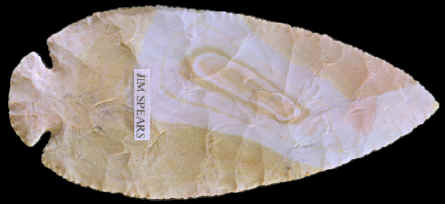
JIM SPEARS, HALL OF FAME FLINTKNAPPER # 5

Jim Spears, the knapper


I have actually never met Jim Spears, but he is one of my favorite knappers. He was mentioned in the Waldorf book, The Art Of Flintknapping, but was sort of a phantom, not caring much for the publishing and so on. To me he was sort of a mystery. Jim Spears met Waldorf in the parking lot of a black powder shoot one day and they hit it off right away, this was when knappers were as rare as hen's teeth. Jim's lithic masterpieces were created in the traditional billet knapping methodology and were prized by collectors of the genera world over. He knapped in the Sollutrean style, at least from what I have seen on film. He has undoubtedly influenced dozens, if not hundreds of knappers. It is difficult to separate the influence of Spears and Waldorf on the knapping world, they are sort of attached at the hip in some respects.

Jim Spears, the knapper that pioneered modern theory of isolated
platforms for large Cado blade thinning, was born September 5th,
1942, and had been interested in artifacts and stone tools all of his
life. . When Jim got out of the Navy he inquired around about
knapping and eventually saw a man using a beer can, or bear bottle
opener to pressure flake the edges of spalls, it was a twisting
motion. This discovery fascinated Jim, but before long he discovered
that a deer antler and dolomite hammerstones were the way to go. Jim
moved to Noel in 1965 and made his first flint point around 1966, he
has made over ten thousand points since. When Jim would get off work
at a trailer making company, he would go out in the woods and knapp.
After many years and many tons of flint he became one of the best
flintknappers of all time, his large, thin, patterned percussion
blades of colorful flint are masterful and each is a work of
art. "Jim pieces" as they are affectionately called by collectors,
fetch a handsome price. The largest noviculite point ever made was
a `Jim peace" and was 20 inches long, and was unheated. Thanks, I will ad this to the web site, thank you. I started knapping in 1969. I was 9 lol. I have been knapping ever since. I am also a fan of other knappers. I did my 1sy newsletter in 1984 and it evntually was given to Val Waldorf and it became "CHIPS" now I am doing flintknapping Blogging, Jim has always been one of my favorites, since I read about him in Waldorf's book. Good evening, Ray, Still haven’t fixed obsidian preform page .. BUT I HAVE been working all day on a bunch of Jim’s points, photographing and developing listings & COA’s for Jim to sign so I can put his points on eBay. The last 4-5 years, I just couldn’t keep up while caring for Mom, too. But now hope to make some money for Jim. Thank you for the link about Jim. He’s my best friend for so many years now, a precious, honorable man and individual to all who know him apart from his phenomenal knapping skills. There’s so many little stories, funny fun things, I will hold forever in my heart… He is how come Missouri Trading Company went from being a hobby tool business to a flintknapping biz. He taught me to knap because I wanted to (ONLY) know how to make a quick weapon or tool for survival in the woods. He kept giving me his rock to destroy so I told him I wanted to find my own. Where could I do that? (thinking a local stream or cave or something.) He said that the rock I liked the best (of his) came from Texas and I should go to Texas. Eh,..Okay. Where? So he told me where, who to see, etc, gave me a 15 minute dissertation on rock checking, patted me on head and said see ya. Five days later after 1500 miles of driving and one major breakdown, I came home with about 800 pounds of stone, mostly knappable. Decided it really wasn’t for me so ran an ad in paper to get rid of the stuff – boy, that got me into it deeper! 14 years later, still growing and selling more and more. That 800 pounds of stone has turned into ??tons. Three crude lead filled boppers have turned into around 35 knapping tools and many accessories that I have developed with help and contributions of others. All the while, Jim has been here, encouraging me, nudging me, critiquing, testing, teaching, me. We are both traders by nature so we understand each other. If it weren’t for him (and others, too) this business would not be anything like it is today. It’s mine but I feel like I’m just along for the ride! If you look in John Whittaker’s book, American Flintknappers, he has a diagram of the learning paths of what I call, the grand daddies of flintknapping. Jim was an originator. Gotta git to work .. sorry for the ramble..Thanks again for the link, will show it to Jim. He may not even know about it. Diana THE A-HED October 6, 2005 . Arrowhead Case: Knapping Hits a Spot For Flint-Stone Fans Manly Types Get a Crush On a Prehistoric Craft; Mr. Spears as 'Rock' Star. Article By GAUTAM NAIK | Staff Reporter of THE WALL STREET JOURNAL "NOEL, Mo. -- Seated on a low bench, Jim Spears used a piece of deer horn to whittle down a heavy chunk of Missouri flint. For an hour, he tapped, whacked and smoothed the hard rock until it was transformed into a delicate and potentially deadly artifact: a replica of an Indian arrowhead known as a Dalton point. "Every stone is different and every stone is a challenge," said Mr. Spears, as he chiseled away and the arrowhead grew thinner and sharper. "It helps me get into the minds of ancient people." At 62 years old, Mr. Spears is one of the country's finest flint knappers, a breed of die-hards who re-create ancient arrowheads, knives and tools using original Stone Age techniques. . More than 10,000 years ago, prehistoric Americans attached sharpened stone "points" to spears and hunted woolly mammoths. In the 1960s and 1970s, a handful of archeologists made basic, often clumsy arrowheads in order to better understand ancient tool making. Since then, knapping has taken off as a surprisingly popular American pastime and art form. Hundreds of modern-day Stone Agers now gather at weekend "knap-ins," where they chip rock, swap techniques and trade arrowheads. Novices eager to learn the skill pay $500 or more to attend workshops. Dozens of books and videos -- including one called "Caught Knapping" -- tout the craft. A glossy magazine for knapping devotees, Modern Lithic Artists Journal, launched last year and featured Mr. Spears's work in the first issue. Another quarterly bible of the trade is called Chips. "It's a manly hobby, because of its association with hunting and weapons," says John Whittaker, an archeologist-knapper at Grinnell College, Grinnell, Iowa. Indeed, some knappers make practical use of their handiwork, hunting deer and other creatures with the carefully honed points. Prof. Whittaker estimates that there are at least 5,000 knappers in the U.S., mostly men, who churn out 1.5 million pieces a year. Replica arrowheads sell on the Internet for $10 to $100 or more apiece, and are increasingly turning up on eBay. One 5-inch "turkey tail" arrowhead, for instance, recently sold for $202.50 at the site, even though its pedigree was unclear. (The seller said it "looks old.") Old-time knappers worry about commercialization of their craft. That's because the best knappers have become so skilled that their work can be difficult to distinguish from Stone Age objects. Some archeologists fret that modern arrowheads are more likely now than in the past to be sold as originals, muddying the historical record. Other purists, such as Errett Callahan, who runs workshops on the traditional approach in Lynchburg, Va., contend that some of today's "wild, modernistic" designs make a mockery of an ancient skill. While newer hobbyists sometimes rely on copper implements -- which most Stone Age people never had -- Mr. Spears insists on doing things the old, old way. A resident of Noel, Mo., he has knapped steadily for four decades. He gathers flint near his home in the Ozarks. He only uses tools available to prehistoric Americans, including bison rib and deer horn, which he obtains from hunts or at a butcher's shop. Even with these crude implements, arrowheads can be carved to be sharper than surgical scalpels. When practicing his craft, Mr. Spears folds a piece of buckskin over his left leg and uses his thigh as an anvil. He holds the stone in his left hand and hits it with a piece of animal horn known as a billet. By delicately adjusting the pressure of his fingers under the rock, he is able to channel the force of the blow along natural lines in the stone, knocking off flakes exactly where he wants. A single wrong strike can ruin a piece. But Mr. Spears intimately understands the physics of percussion. "He can do things to a rock that are miraculous," says Bob "BigFlint" Hunt, a knapper from Oak Grove, Mo., who has known Mr. Spears for more than two decades. Another colleague recalls that at a small 1993 gathering, everyone dropped their tools to watch Mr. Spears chisel a complicated turkey tail arrowhead. After spending four years in the Navy, Mr. Spears did a brief stint at junior college. While there, he saw a friend craft an arrowhead by flaking a piece of flint with a beer opener. In a book for Boy Scouts, Mr. Spears read that prehistoric Americans had used deer horn to chisel points; he decided to do the same. "I was enthralled by the idea," he says. "I began to chip all the time." Jim Spears knaps a piece of raw Missouri flint into a Dalton point arrowhead. . One day, as he crouched on a rocky bluff hitting a stone, a man pulled over in his car and shouted: "Hey, what you doing there?" "Making arrowheads," Mr. Spears answered back. The man paused, then shook his head and drove off. "Guess he thought I was nuts," says the knapper. Over the years, Mr. Spears taught himself to knap increasingly intricate designs such as the exquisitely fluted "Folsom point." Eventually, his lifestyle began to reflect his obsession. He took to hunting deer with a bow and arrow. He sometimes sat around a fire and skinned carcasses with stone implements he had made. Mr. Spears's large house in the middle of the Ozark hills is bare, except for a few Indian rugs and a mattress on the floor. Though he has an old telephone -- which he's been known to unplug -- he doesn't own a wristwatch. In one room he stores 40 large pieces of bamboo, from which he carves bows and arrows. He has never married. His longtime girlfriend, who is part Native American, lives several miles away. It's hard to make a living from knapping alone. Mr. Spears, who used to dabble in construction work before taking up his craft full-time, says the Internet has lately damped his arrowhead sales. So he also trades other Native American products through a friend, Diana Benson. Her mail-order knapping supply firm sells Mr. Spears's arrowheads, as well as rugs and baskets, on the Internet. The shelves of her Missouri Trading Company store, in Pineville, Mo., are heaped with rocks, tools and about 30 instructional video titles -- including one starring Mr. Spears. Mr. Spears attends about four knap-ins each year. One recent weekend, he stowed his tools and workbench in his pickup, and drove 250 miles north to the Fort Osage knap-in, held in a field in northern Missouri. Along the way, he snacked on dried fruits and deer jerky made from an animal he had killed. At the event, more than 100 knappers from Iowa, Illinois, Texas and elsewhere, sat in circles and, for hours, whacked away at rocks. Most were middle-aged men -- carpenters, jewelry makers and at least one professional archaeologist. At one tent, a vendor from Leavenworth, Ind., hawked 1,800 pounds of stone, including jasper and chert. Another attendee described how he felled a deer using an arrow tipped with a stone point. Mr. Spears didn't even take out his tools. Fellow knappers said they were already in awe of his skill and that he had little to prove anymore. When one collector proudly noted that certain arrowheads could fetch hefty prices, Mr. Spears was bemused. "When you get right down to it," he said, "it's nothing but rocks." "
The International Flintknappers ‘ Hall of Fame and Museum is encouraging individuals of all ages to “Be A Superior Example,” through a new education program as part of a new curriculum to promote healthy habits, while encouraging everyone to live free of drugs and other such substances or vices. It serves as the central point for the study of the history of flintknapping in the United States and beyond, displays flintknapping-related artifacts and exhibits, and honors those who have excelled in the craft, research/ writing, promoting events, and serving the knapping community in an ethical and wilderness loving manner.

Thursday, January 17, 2013

J.B. SOLLBERGER, HALL OF FAME FLINTKNAPPER # 4


By Ray Harwood


THE TEXAS MASTER; In the states of Texas was a long lean bloke, it
wasn't Johnny Smoke, it was paleo flintknapping pioneer, J.B. ( Photo By Thompson)
Sollberger. I was aquatinted with Mr. Sollberger and know that he was
a true master flintknapper and influence to hundreds.
Though they were contemporary, Carabtree and Texan, J.B. Sollberger
spurred on two separate schools of thought. Crabtree the obsidian
school and Sollberger the Texas flint school. Though both are
flintknapping, the methodology is very different.
In the realm of thought and mental visualization, deep in the mind is
the perfect visualization or pure idea, the mental template. For most
craftsmen by the time this idea becomes a piece of work it has lost a
bit of perfection. On rare occasion it is manifested in a piece of
art work, this was the case with the magnificent flintwork of J.B.
Sollberger, of Dallas, Texas.
Sollberger was a true flintknapping pioneer and a legend in his time.
Not only was Sollberger a master knapper, he was truly a gentleman
and humble as well. He was very analytical with his theoretical
papers and articles being the best in the field. His literary works
were of the highest quality where he published in many journals
including American Antiquity, Lithic Technology, Flintknappers'
Exchange, Flintknapping Digest, and The Emic Perspective.
J.B. Sollberger started flintknapping when he was middle aged, some
time around 1970. He always had a curiosity about knapping but didn't
get the "lithic erg" until he observed a scrapper making
demonstration at the 1970 Dallas Archaeological Society meetings.
Ironically Don Crabtree came to Dallas to the meetings but J.B.
Sollberger had to work so he missed the opportunity to meet Crabtree.
The next week he tried to make up for it buy going on his first flint
hunt and ordering Crabtrees book. Upon reading this, Sollberger got a
basic tool kit together and began experimenting.
Sollberger recalled seeing a forked stick in a museum in Texas as a
boy and began experimenting with his famous "fork and lever" knapping
style. Sollberger was very successful in his experiments and was soon
making fine arrow heads with his rig.
According to Sollberger (1978) " back in 1933 I suppose, we were just
boy artifact collectors. We made this trip to San Antone to see the
Witte Museum and inside they had a forked stick a little over a foot
long with something like 3/4 of an inch gap between the two forks. It
struck me that pressure flaking could be done with leverage by laying
the biface material across this forked stick and using the fork as a
fulcrum for a lever".
In 1990, John Wellman spoke to Solly and said that Solly was really
interested in the East Wenatchee Site in Washington and he had made
several large fluted points including an eight inch Cumberland he had
spend eight hours preparing and fluted off the tip. This was really
advanced work for the year and to me Sollberger's work remains
unsurpassed.
Bob Vernon, an old time Texas knapper once conveyed this story about
Sollberger to me: " If any of you ever had the privilege of sitting
alongside Solly at a small knapping session, you'll remember his dry,
but gentle, humor. Like the times when he would say, " That platform
looks a like a strong `un- guess I better drag out ol' "he-poppa-ho"
(his mega-moose billet)."
Almost all Sollberger's work was in flint or chert, I have only seen
one item made by Sollberger of obsidian. The obsidian point is in the
collection of Steve Carter, a master flintknapper from Ramona,
California. The obsidian point was very nice and very delicate, this
shows the diversity in craftsmanship Sollberger had. The last time I
spoke to J.B. Sollberger he was crafting a set of masterful flint
Folsom points out of Texas flint. He had made quite a few thousand
points in his time and was using 1,000 pounds of flint a year. Even
when Sollberger was quite old he continued being very active in
knapping and writing. In a letter from Sollberger to Steve Behrnes
Sollberger described this incredible expedience, " My house, on
Monday nights, is known as the Sollberger Clovis Factory. Joe Miller
and Woody Blackwell made Tee Shirts to that name which we often wear.
Dr. Ericson, David Hartig,Gene Stapleton, Jess Nichols, are regulars
who concentrate on fluting." J.B. Sollberger died on Sunday, May 7 at
Baylor University Medical Center in Dallas from emphysema. He was 80
years old. Many rumors have surfaced in the years after his death,
that Solly died of silicosis, this is simply untrue. According to the
Dallas Morning News, Solly donated his collection to the University
of Texas, where they will be used for study. In my collection I have
several Sollberger points, the one that is my favorite has written on
it "to my friend Ray Harwood from J.B. Sollberger," I use that point
as inspiration for my own knapping.


///////////////////////////////////////////////////////////////////////////////////////////////////
THE TEXAS MASTER; In the states of Texas was a long lean bloke, it
wasn't Johnny Smoke, it was paleo flintknapping pioneer, J.B.
Sollberger. I was aquatinted with Mr. Sollberger and know that he was
a true master flintknapper and influence to hundreds.
Though they were contemporary, Carabtree and Texan, J.B. Sollberger
spurred on two separate schools of thought. Crabtree the obsidian
school and Sollberger the Texas flint school. Though both are
flintknapping, the methodology is very different.
In the realm of thought and mental visualization, deep in the mind is
the perfect visualization or pure idea, the mental template. For most
craftsmen by the time this idea becomes a piece of work it has lost a
bit of perfection. On rare occasion it is manifested in a piece of
art work, this was the case with the magnificent flintwork of J.B.
Sollberger, of Dallas, Texas.
Sollberger was a true flintknapping pioneer and a legend in his time.
Not only was Sollberger a master knapper, he was truly a gentleman
and humble as well. He was very analytical with his theoretical
papers and articles being the best in the field. His literary works
were of the highest quality where he published in many journals
including American Antiquity, Lithic Technology, Flintknappers'
Exchange, Flintknapping Digest, and The Emic Perspective.
J.B. Sollberger started flintknapping when he was middle aged, some
time around 1970. He always had a curiosity about knapping but didn't
get the "lithic erg" until he observed a scrapper making
demonstration at the 1970 Dallas Archaeological Society meetings.
Ironically Don Crabtree came to Dallas to the meetings but J.B.
Sollberger had to work so he missed the opportunity to meet Crabtree.
The next week he tried to make up for it buy going on his first flint
hunt and ordering Crabtrees book. Upon reading this, Sollberger got a
basic tool kit together and began experimenting.
Sollberger recalled seeing a forked stick in a museum in Texas as a
boy and began experimenting with his famous "fork and lever" knapping
style. Sollberger was very successful in his experiments and was soon
making fine arrow heads with his rig.
According to Sollberger (1978) " back in 1933 I suppose, we were just
boy artifact collectors. We made this trip to San Antone to see the
Witte Museum and inside they had a forked stick a little over a foot
long with something like 3/4 of an inch gap between the two forks. It
struck me that pressure flaking could be done with leverage by laying
the biface material across this forked stick and using the fork as a
fulcrum for a lever".
In 1990, John Wellman spoke to Solly and said that Solly was really
interested in the East Wenatchee Site in Washington and he had made
several large fluted points including an eight inch Cumberland he had
spend eight hours preparing and fluted off the tip. This was really
advanced work for the year and to me Sollberger's work remains
unsurpassed.
Bob Vernon, an old time Texas knapper once conveyed this story about
Sollberger to me: " If any of you ever had the privilege of sitting
alongside Solly at a small knapping session, you'll remember his dry,
but gentle, humor. Like the times when he would say, " That platform
looks a like a strong `un- guess I better drag out ol' "he-poppa-ho"
(his mega-moose billet)."
Almost all Sollberger's work was in flint or chert, I have only seen
one item made by Sollberger of obsidian. The obsidian point is in the
collection of Steve Carter, a master flintknapper from Ramona,
California. The obsidian point was very nice and very delicate, this
shows the diversity in craftsmanship Sollberger had. The last time I
spoke to J.B. Sollberger he was crafting a set of masterful flint
Folsom points out of Texas flint. He had made quite a few thousand
points in his time and was using 1,000 pounds of flint a year. Even
when Sollberger was quite old he continued being very active in
knapping and writing. In a letter from Sollberger to Steve Behrnes
Sollberger described this incredible expedience, " My house, on
Monday nights, is known as the Sollberger Clovis Factory. Joe Miller
and Woody Blackwell made Tee Shirts to that name which we often wear. The International Flintknappers ‘ Hall of Fame and Museum is encouraging individuals of all ages to “Be A Superior Example,” through a new education program as part of a new curriculum to promote healthy habits, while encouraging everyone to live free of drugs and other such substances or vices. It serves as the central point for the study of the history of flintknapping in the United States and beyond, displays flintknapping-related artifacts and exhibits, and honors those who have excelled in the craft, research/ writing, promoting events, and serving the knapping community in an ethical and wilderness loving manner.